




Saṃskṛta is not a mere transactional language. It is a Knowledge Paramparā. This article series helps us to explore the vast richness of this Bharatiya Jñāna Paramparā (Indian Knowledge Systems)
Saṃskṛta is a doorway to the vast and deep Bharatiya Jñāna Paramparā. Across generations, thinkers, teachers, poets, commentators and practitioners have added their own insight to this living tradition like placing one brick after another in a great temple of knowledge. Each paramparā has gone deep into words, meanings, practices and principles through study, contemplation and experience. Therefore, Indian Knowledge Systems are both vast in their expanse and profound in their depth. This article series is an attempt to explore that richness of knowledge through the lens of Saṃskṛta.
For previous articles in this series, please refer –
I. An Illustrative Representation of the Knowledge Repository in Sanskrit – https://www.vyoma.org/what-sanskrit/#
II. Overview of the Veda-s – https://www.vyoma.org/new-letter/ Newsletter – December 2022 | Vol. 6 | Issue 1
III. Overview of the Vedanga-s – https://www.vyoma.org/blog-post/what-is-sa%e1%b9%83sk%e1%b9%9btam/
IV. Ayurveda – https://www.vyoma.org/new-letter/ Newsletter – JUNE 2025 | Vol.8 | Issue 1
V. Dhanurveda: The Science of Warfare and Wisdom in Indian Knowledge Systems https://www.vyoma.org/blog-post/dhanurveda-the-science-of-warfare-and-wisdom-in-indian-knowledge-systems/
VI. Gāndharvaveda: The Science of Music and Dance in Indian Knowledge Systems
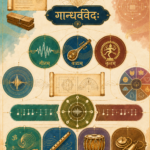
Gāndharvaveda is the Upaveda of the Sāmaveda that systematises song (gīta), instrumental music (vādya), and dance (nṛtta) into an integrated science of Indian classical music, dance and theatre, rooted in Vedic tradition and later codified in Bharata Muni’s Nāṭyaśāstra.
Upaveda-s are often regarded as supplementary or associated śāstra-s to the four Veda-s, presenting the applied aspects of Vedic wisdom across various fields. Āyurveda is considered an Upaveda of the Ṛgveda; Dhanurveda, of the Yajurveda. Gāndharvaveda is associated with the Sāmaveda, and Arthaśāstra & Sthāpatyaveda with the Atharvaveda. (as per the Caraṇavyūhasūtra of Śrī Śaunaka)
आयुर्वेदो धनुर्वेदो गान्धर्ववेदोऽर्थशास्त्रं चेति चत्वार उपवेदाः ।
āyurvedo dhanurvedo gāndharvavedo’rthaśāstraṃ ceti catvāra upavedāḥ ।
(Prasthānabheda, Madhusūdana Sarasvatī)
The four Upaveda-s are Āyurveda (science of life), Dhanurveda (warfare), Gāndharvaveda (music and the arts), and Arthaśāstra (governance).
In the previous Newsletters, we have explored Āyurveda (the science of life) and Dhanurveda (the science of warfare). In this Newsletter, let us turn to Gāndharvaveda, the Upaveda of the Sāmaveda, which systematises Gīta (vocal music), Vādya (instrumental music), and nṛtta (dance) as a single, integrated science of of Indian classical music, dance and theatre . Its very name recalls the gandharva-s, the celestial musicians of the deva-s, indicating that for the Indian tradition music and dance were never mere entertainment but a path of upāsanā and sādhanā.
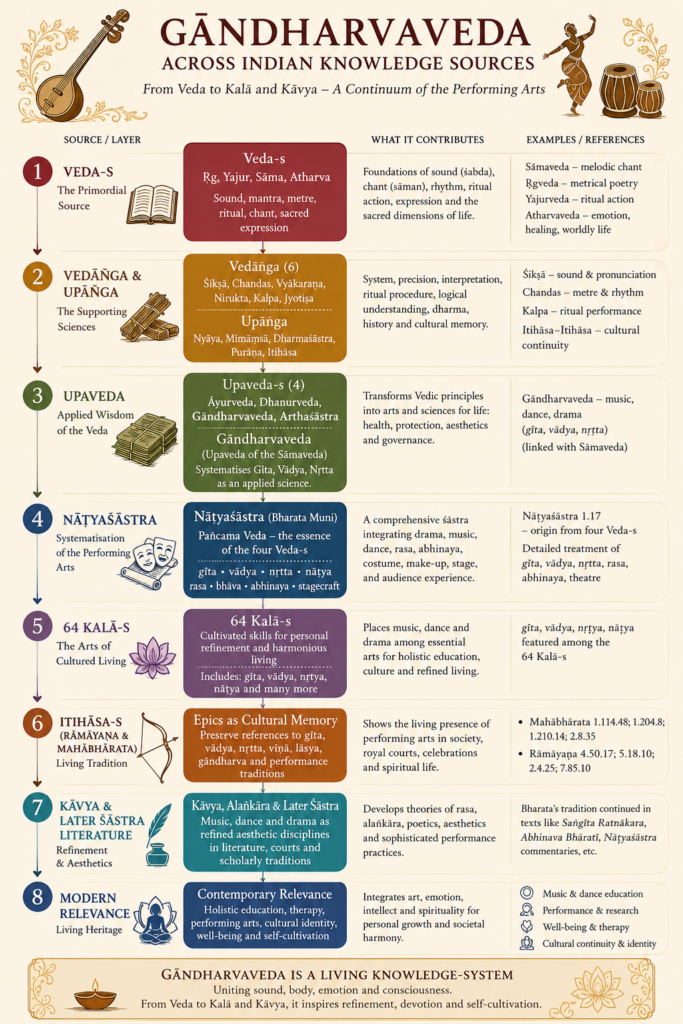
To understand Gāndharvaveda within Indian Knowledge Systems, it is useful to trace a layered movement: from the Veda-s, where sound, chant, metre, ritual and sacred performance appear in seed form; to the Vedāṅga-s and Upāṅga-s, which provide linguistic, ritual, interpretive and philosophical frameworks; to the Upaveda-s, where applied knowledge is systematised; and then to the 64 kalā-s.
Purpose of Gāndharvaveda
Madhusūdana Sarasvatī, in the Prasthānabheda, states the purpose of Gāndharvaveda concisely;
गीतवाद्यनृत्तभेदेन बहुविधोऽर्थः ।
देवताराधन-निर्विकल्पक-समाध्यादि-सिद्धिश्च गान्धर्ववेदस्य प्रयोजनम् ॥
gītavādyanṛttabhedena bahuvidho’rthaḥ ।
devatārādhana-nirvikalpaka-samādhyādi-siddhiśca gāndharvavedasya prayojanam ॥
(Prasthānabheda, Madhusūdana Sarasvatī)
Through the distinctions of song, instrument, and dance, manifold purposes are served; and the attainment of states such as the worship of the deities and non-conceptual absorption is the purpose of Gāndharvaveda.
This is the spine of the entire tradition; the performing arts are simultaneously aesthetic, devotional and contemplative. The same gīta that delights the ear can become an offering to the divine and an entry to samādhi.
1. Vedic Roots and the Systematisation in the Nāṭyaśāstra
The roots of music, chant and sacred performance in the Indian tradition go back to the Veda-s themselves. The Sāmaveda especially preserves the tradition of melodic chanting, while Vedic ritual also includes recitation, rhythm, intonation, movement and ceremonial performance. These early references show that sound, rhythm and sacred expression were central to Vedic culture.
Building upon this foundation, the Nāṭyaśāstra of Bharata Muni (2nd cent. CE) emerges as the earliest surviving systematic and influential treatise that brings drama, dance, music, aesthetics, stagecraft, gesture, ritual and performance practice into one comprehensive śāstric framework.
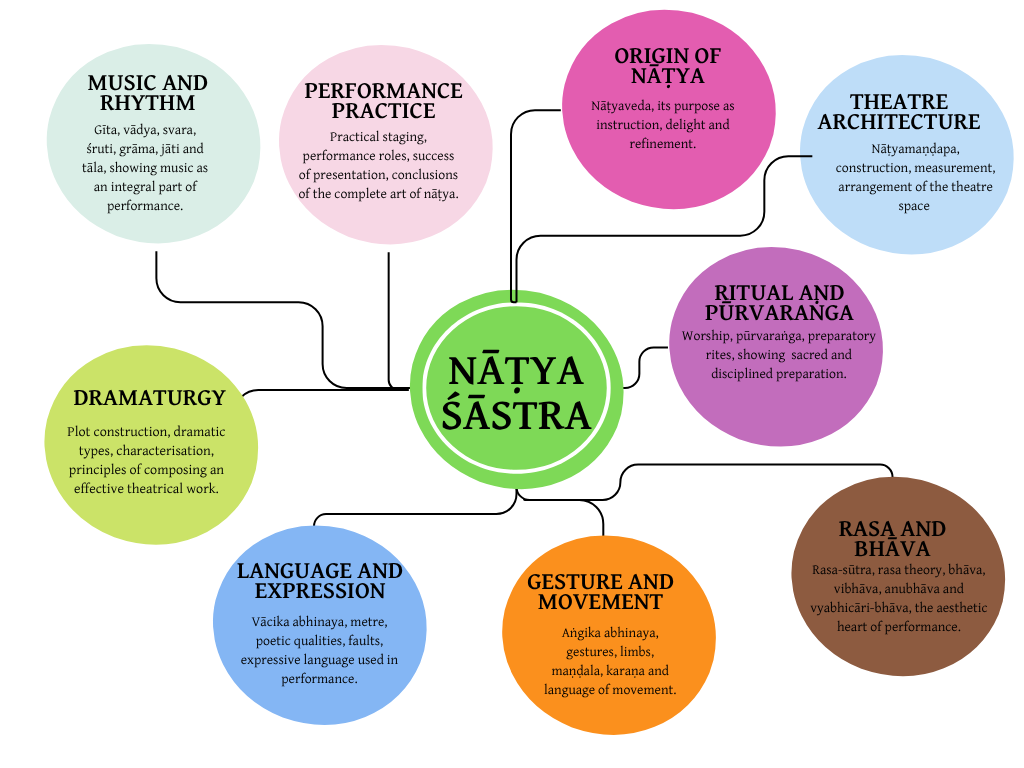
Bharata frames the performing arts as a pañcama Veda, a fifth Veda, drawn from the essence of the four
जग्राह पाठ्यमृग्वेदात् सामभ्यो गीतमेव च ।
यजुर्वेदादभिनयान् रसानाथर्वणादपि ॥
jagrāha pāṭhyamṛgvedāt sāmabhyo gītameva ca ।
yajurvedādabhinayān rasānātharvaṇādapi ॥
(Nāṭyaśāstram 1.17)
Brahmā drew recitation from the Ṛgveda, song from the Sāmaveda, gesture and enactment from the Yajurveda, and the aesthetic sentiments from the Atharvaveda.
The distribution in this verse is meaningful. Pāṭhya or recitable text is taken from the Ṛgveda because the Ṛgveda is primarily a collection of metrical mantra-s and poetic utterances. Gīta is drawn from the Sāmaveda because the Sāmaveda preserves the tradition of melodic chanting. Abhinaya is linked with the Yajurveda because the Yajurveda is closely connected with ritual action, gesture and the performance of sacrificial procedure. Rasa is associated with the Atharvaveda because it deals more directly with human experience, emotion, healing, protection, fear, desire and worldly life.
It is significant that gīta, song, is drawn specifically from the Sāmaveda, the Veda of melody and chant. This is the textual basis for associating Gāndharvaveda with the Sāmaveda. The Sāmaveda largely consists of Ṛgvedic verses adapted for melodic chanting.
The Nāṭyaśāstra recognises four traditional classes of instruments; Tata, Avanaddha, Ghana and Suṣira while the Saṅgīta Ratnākara explains them in detail from śloka 402 to śloka 1214.
| Class | Nature and examples |
| Tata (तत) | Stringed instruments – vīṇā, and its many classical forms |
| Suṣira (सुषिर) | Hollow instruments – vaṃśa (flute), śaṅkha |
| Avanaddha (अवनद्ध) | Membrane-Covered – mṛdaṅga, paṭaha |
| Ghana (घन) | Solid struck instruments – tāla (cymbals), ghaṇṭā |
Music and Instruments in the Vedāṅga Tradition
A reference to vīṇā appears in Pāṇini’s Aṣṭādhyāyī, generally dated between the 6th BCE. The sūtra 3.1.25 includes vīṇā among the bases to which ṇic is prescribed, and 3.3.65 mentions vīṇā again in connection with sound. Another relevant sūtra, द्वन्द्वश्च प्राणितूर्यसेनाङ्गानाम् (Aṣṭādhyāyī 2.4.2), refers to tūrya, a term connected with musical instruments. Its grammatical treatment suggests that instruments were recognised not only individually, but also as a collective instrumental group. These references indicate that vīṇā-vādana and musical instruments were familiar enough to be recognised within the grammatical tradition.
Music in Saṃskāra: A Gṛhyasūtra Reference
The ritual dimension of the same tradition is seen in the Āpastamba Gṛhyasūtra, where music appears within the context of the saṃskāra connected with pregnancy:
गायतमिति वीणागाथिनौ संशास्ति । (अध्यायः ६, खण्डः १४, ६.१४)
gāyatam iti vīṇāgāthinau saṃśāsti (Adhyāya 6, khaṇḍa 14, 6.14)
He directs the two vīṇā-accompanied singers to sing.
This statement is valuable from the perspective of Gāndharvaveda because it shows that music was present not only in later devotional or dramatic contexts, but also within the structure of gṛhya ritual. The presence of vīṇā and song in a pregnancy-related saṃskāra points to the role of refined sound in creating auspiciousness, mental calmness and a harmonious atmosphere for the mother and the unborn child.
Gāndharvaveda as Devatārādhana
The devotional dimension of Gāndharvaveda is beautifully expressed in the Pradoṣa Stotra, traditionally attributed to Sage Upamanyu:
वाग्देवी धृतवल्लकी शतमखो वेणुं दधत् पद्मजः
तालोन्निद्रकरो रमा भगवती गेयप्रयोगान्विता ।
विष्णुः सान्द्रमृदङ्गवादनपटुर्देवाः समन्तात् स्थिताः
सेवन्ते तमनु प्रदोषसमये देवं मृडानीपतिम् ॥ प्रदोषस्तोत्रम्
vāgdevī dhṛtavallakī śatamakho veṇuṃ dadhat padmajaḥ
tālonnidrakaro ramā bhagavatī geyaprayogānvitā ।
viṣṇuḥ sāndramṛdaṅgavādanapaṭurdevāḥ samantāt sthitāḥ
sevante tamanu pradoṣasamaye devaṃ mṛḍānīpatim.
At the time of Pradoṣa, Sarasvatī holds the vallakī (veena), Indra holds the flute,Brahmā keeps the rhythm, Lakṣmī joins in singing, Vishnu expertly plays the deep mṛdaṅga, and the gods stand all around, serving the Bhagavān Śiva, the consort of Parvati.
Though this verse belongs to a later devotional tradition and not to the earliest chronological layer of Vedic literature, it is important for understanding the continued cultural life of Gāndharvaveda. It shows the Deva-s themselves employing different aspects of Gāndharvaveda, i.e., gīta, vādya, tāla and nṛtya in the service of Śiva. Sarasvatī’s presence with the vallakī is especially significant, as it links vāṇī, knowledge, refined sound and musical expression. The verse therefore presents Gāndharvaveda as a disciplined and elevated art in which knowledge, rhythm, melody, beauty and devotion come together.
2. Saṅgīta – The Threefold Art of Indian Classical Music
By the classical period, the term saṅgīta came to denote the unified art of music. The much-quoted definition crystallises it as a union of three elements
गीतं वाद्यं तथा नृत्तं त्रयं सङ्गीतमुच्यते ।
gītaṃ vādyaṃ tathā nṛttaṃ trayaṃ saṅgītamucyate ।
(Saṅgīta-ratnākara – 1.21)
Song, instrumental music and dance; these three together are called saṅgīta.
This threefold conception of song, instrumental music and dance receives its most influential treatment in Śārṅgadeva’s Saṅgīta-ratnākara, an authoritative text for both the Hindustānī and Carnatic traditions.
In this definition, nṛtta indicates the dance component of saṅgīta. The later section on textual tradition explains the finer distinction between nṛtta and nṛtya.
Kīrtana as Integrated Saṅgīta
A later Purāṇic reference from the Śrīmad Bhāgavata Māhātmya of the Padma Purāṇa presents kīrtana as a complete musical and aesthetic expression:
प्रह्लादस्तालधारी तरलगतितया चोद्धवः कांस्यधारी
वीणाधारी सुरर्षिः स्वरकुशलतया रागकर्तार्जुनोऽभूत् ।
इन्द्रोऽवादीन्मृदङ्गं जयजयसुकराः कीर्तने ते कुमाराः
यत्राग्रे भाववक्ता सरसरचनया व्यासपुत्रो बभूव ॥ ८६ ॥
Prahlādastāladhārī taralagatitayā coddhavaḥ kāṃsyadhārī
vīṇādhārī surarṣiḥ svarakuśalatayā rāgakartārjuno’bhūt ।
Indro’vādīn mṛdaṅgaṃ jayajayasukarāḥ kīrtane te kumārāḥ
yatrāgre bhāvavaktā sarasaracanayā Vyāsaputro babhūva ॥ 86 ॥
Padma Purāṇa, Śrīmad Bhāgavata Māhātmya 13.6.86
Prahlāda became the keeper of tāla, and Uddhava, with graceful movement, held the cymbal. The divine sage Nārada held the vīṇā, while Arjuna, skilled in svara, became the creator of rāga. Indra played the mṛdaṅga, and the Kumāra-s joyfully sang “jaya, jaya” in the kīrtana. In front of them, Vyāsa’s son Śuka became the speaker of bhāva through graceful expression.
This verse brings together tāla, vādya, svara, rāga, kīrtana and bhāva-vaktṛtva in one devotional setting. The named figures are not passive listeners; each participates through a distinct musical or expressive role. It is therefore a useful later reference showing how the integrated ideal of saṅgīta continued to live within Purāṇic bhakti practice.
From Integrated tradition to Specialised Art Forms
Originally, the idea was broad and integrated, bringing the performing arts together within one framework.
Over time, however, music, dance and drama gradually developed into separate streams, each with its own texts, techniques and performance traditions. Music developed detailed systems of rāga, tāla and composition; dance focused on movement, abhinaya, gesture and choreography; and drama developed around plot, character, dialogue and stage presentation. Thus, in present-day usage, saṅgīta usually refers mainly to music, while dance and drama are treated as related but distinct disciplines.
3. Rasa and Bhāva – The aesthetic heart
If saṅgīta is the body of Gāndharvaveda, rasa, aesthetic experience, is its soul. Bharata’s celebrated rasa-sūtra states the mechanism by which emotion becomes art;
विभाव-अनुभाव-व्यभिचारि-संयोगाद् रसनिष्पत्तिः ।
vibhāvānubhāvavyabhicārisaṃyogādrasaniṣpattiḥ ।
(Nāṭyaśāstra, rasa-sūtra – Ch. 6)
Rasa arises from the union of the determinants, the consequent, and the transitory states acting upon a stable emotion.
Bharata enumerated eight rasa-s, each grounded in a stable emotion (sthāyi-bhāva). Śānta-rasa was given fuller theoretical status in the later tradition, especially through Abhinavagupta (10th–11th c.) in his commentary, the Abhinavabhāratī. The nine rasa-s (navarasa) are;
| Rasa | Sthāyi-bhāva | Sentiment |
| Śṛṅgāra | Rati (love) | Romantic |
| Hāsya | Hāsa (mirth) | Comic |
| Karuṇa | Śoka (grief) | Compassionate |
| Raudra | Krodha (anger) | Furious |
| Vīra | Utsāha (energy) | Heroic |
| Bhayānaka | Bhaya (fear) | Fearful |
| Bībhatsa | Jugupsā (disgust) | Odious |
| Adbhuta | Vismaya (wonder) | Marvellous |
| Śānta | Śama (tranquillity) | Peaceful |
The closely related theory of dhvani (poetic suggestion), set out by Ānandavardhana in the Dhvanyāloka (9th c.) and developed in the Locana of Abhinavagupta, deepened the understanding of how art evokes rasa through what is implied rather than stated.
4. The textual tradition – A chronological map
Gāndharvaveda survives through a continuous chain of śāstra-s, all ultimately rooted in the Nāṭyaśāstra. The following is not an exhaustive list, but a representative map of major texts across drama, music, dance, and aesthetic theory.
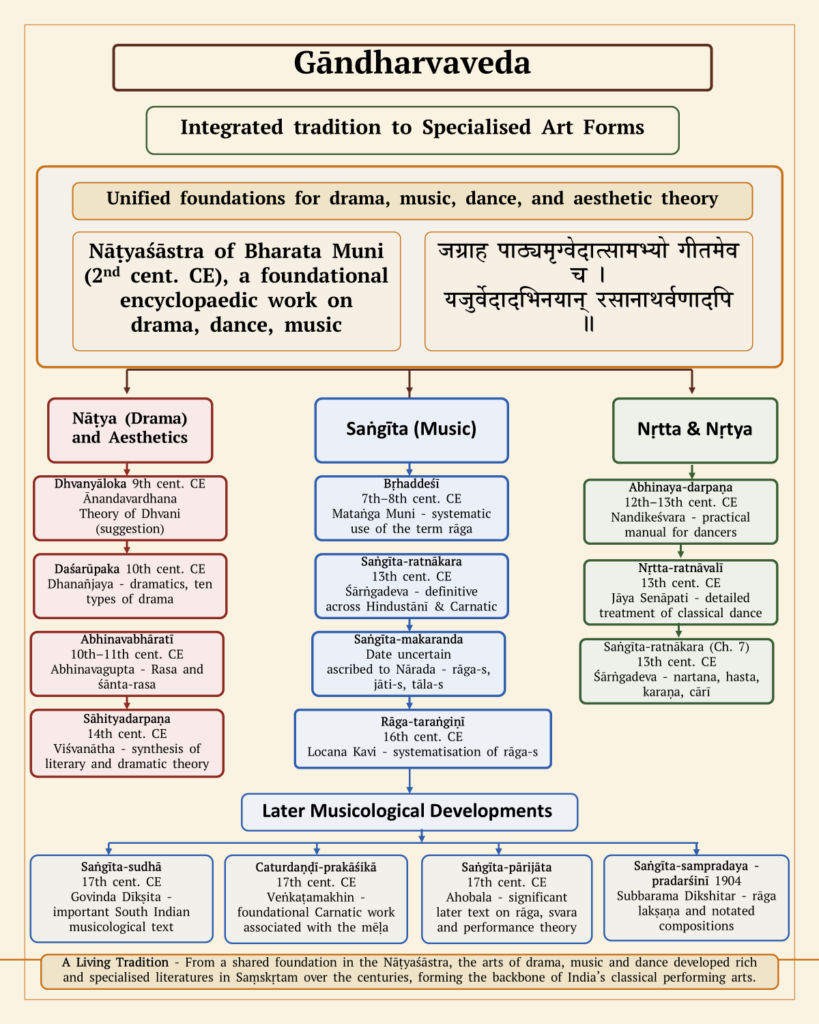
The tradition draws a careful distinction within dance itself. Nṛtta is pure dance, devoid of rasa and bhāva, consisting of movement and rhythm for their own sake, while nṛtya is expressive dance that carries rasa, bhāva, and suggestion (vyañjanā).
भावाभिनयहीनं तु नृत्तमित्यभिधीयते ॥ १५ ॥
bhāvābhinayahīnaṃ tu nṛttamityabhidhīyate ॥ 15 ॥
But that which is devoid of mood and enactment is called nṛtta (pure dance).
रसभावव्यञ्जनादियुक्तं नृत्यमितीर्यते ॥ १६ ॥
rasabhāvavyañjanādiyuktaṃ nṛtyamitīryate ॥ 16 ॥
That which is endowed with emotion, mood (bhāva), suggestion (vyañjanā), and so forth is called nṛtya (expressive dance).
(Abhinaya-Darpaṇam 1.15-16)
The continuity of Gāndharvaveda is also visible beyond the śāstric texts. In the traditional list of 64 kalā-s, gīta, vādya, nṛtya and nāṭya appear among the foremost arts, showing that music, instrumental skill, dance and theatrical expression were treated as cultivated disciplines within refined education and cultural life.
The Itihāsa-s also preserve important references to the performing arts. The Mahābhārata mentions the divine gandharva-s Hāhā and Hūhū as renowned for the sweetness of song (Mahābhārata 1.114.48), refers to service through vādya, nṛtta and songs of praise (Mahābhārata 1.204.8), mentions awakening through sweet song and the sound of the vīṇā (Mahābhārata 1.210.14), and describes gandharva-s and apsaras along with vādya, nṛtta, gīta, hāsya and lāsya (Mahābhārata 2.8.35).
Similarly, the Rāmāyaṇa refers to Hemā as skilled in nṛtta and gīta (Rāmāyaṇa 4.50.17), to the combined enjoyment of gīta, nṛtta and vādya (Rāmāyaṇa 5.18.10), to the vīṇā as an established instrument (Rāmāyaṇa 2.4.25), and to gāndharva as an extraordinary musical performance that delighted the listeners (Rāmāyaṇa 7.85.10).
Later kāvya-śāstra literature further continues this cultural vision, where music, dance and drama become markers of refined learning and aesthetic cultivation. This continuity helps us see Gāndharvaveda not merely as “music”, but as a living knowledge-system connecting sound, body, emotion, aesthetics, worship, education and self-cultivation.
5. Gāndharvaveda within Indian Knowledge Systems (IKS)
Within the IKS framework, Gāndharvaveda integrates art, devotion, and inner discipline into a single system. Its distinctive contributions include;
- Nāda as the root of music – Indian thought understands nāda not merely as physical sound, but as a subtle principle linking outer music with inner experience. The tradition also speaks of nādānusandhāna, the contemplative practice of following or meditating upon sound as a means of inner refinement.
In this view, sound moves from its most subtle to its audible form through four levels: parā (the undifferentiated source of sound), paśyantī (the first subtle emergence), madhyamā (the inner mental form), and vaikharī (the expressed, audible sound). Thus, svara, rāga and tāla are not only musical categories, but can also become instruments of devotion, concentration and spiritual discipline.
The fourfold understanding of sound is also reflected in the Lalitā-sahasranāma. It describes Devī as “parāpratyakcitīrūpā, paśyantī paradevatā, madhyamā vaikharīrūpā,” thereby associating her with the four levels of speech; parā, paśyantī, madhyamā and vaikharī. Bhāskararāya, in his Saubhāgyabhāskara commentary, further elaborates this understanding of vāk. This reference strengthens the idea that nāda is not merely an external sound, but has subtle, inner and expressed dimensions.
- Integration of the arts – gīta, vādya and nṛtta are treated not as separate skills but as one coordinated discipline, governed by shared principles of rasa and tāla.
- Art as sādhana – through bhakti and performance, the arts become vehicles of adhyātmika sādhana.
- A complete aesthetic philosophy – rasa and dhvani theory remain among the most sophisticated frameworks of aesthetics produced anywhere in the ancient world.
6. Contemporary Relevance
The principles of Gāndharvaveda continue to find living and scholarly application in Indian classical music, dance and theatre today.
- Śāstrīya saṅgīta – the academic revival and study of classical music grounded in the rāga-rasa siddhānta, the theory linking specific melodies to specific moods.
- Nāda-cikitsā – Modern research is exploring the possible therapeutic effects of music and sound.
- Preservation of tradition – documentation of classical instruments and performance styles linked to Veda-mantra-gāna, and of regional theatre forms such as Kūṭiyāṭṭam and Yakṣagāna that carry Bharata’s ideas forward.
- Aesthetics and the mind – rasa theory increasingly informs modern conversations in psychology, performance studies, and the study of emotion in art.
- Contemporary skill development: Gāndharvaveda also connects with many present-day skill areas. Music, dance and theatre help develop communication, expression, rhythm, memory, teamwork, emotional sensitivity, stage presence and creative confidence. These skills are valuable in education, media, cultural industries, public speaking, content creation, performance training and holistic personality development. These benefits of learning Indian classical music, dance and theatre extend well beyond performance itself, shaping communication, discipline and confidence that carry into everyday life.
The present article attempts to bring together the major dimensions of Gāndharvaveda. Each of these areas opens a much larger field of study, including textual references, historical development, performance traditions, regional practices and modern applications. This article may therefore be viewed as only the tip of the iceberg in the vast ocean of Indian Knowledge Systems. Gāndharvaveda opens many further paths of enquiry, and each of its dimensions deserves deeper source-based study by interested researchers and scholars.
Conclusion
Gāndharvaveda shows that Indian Knowledge Systems did not separate art from life. Music, dance and drama were connected with education, worship, psychology, ethics and community refinement. It treats sound not merely as acoustic vibration, but as a disciplined force that links outer expression with inner experience. Through nāda, rāga, tāla, abhinaya, nṛtta and nāṭya, the tradition brings together śāstra and prayoga, theory and lived practice. In this vision, both the performer and the spectator are transformed: the artist refines expression through sādhana, while the sensitive listener or viewer experiences rasa. The theory of rasa gives Indian aesthetics a unique understanding of emotion, showing how feeling is universalised and aesthetically relished. Thus, Gāndharvaveda elevates the performing arts beyond entertainment and presents them as a path of refinement and devotion. Its relevance continues today, especially in holistic education, where music, movement, emotion and cultural identity can be meaningfully integrated.
Gāndharvaveda reminds us that beauty, when disciplined by śāstra and offered with devotion, becomes a path of self-cultivation.
Research – Dr. Leena R. Doshi
Guidance – Dr. Sowmya Krishnapur, Dr. CA. Viswanathan and Dr. Venkatasubramanian P
Primary Sources & References
- Bharata Muni, Nāṭyaśāstram, ed. Paṇḍita Kedārnātha (Sāhityabhūṣaṇa) (Bombay: Nirṇaya Sāgara Press, 1943), Ch. 1 (Nāṭyotpatti, verse 1.17, on the four Vedas) and Ch. 6 (rasa-sūtra; the eight rasas), p. 2.
- Bharatamuni, Nāṭyaśāstram, with the Abhinavabhāratī commentary of Abhinavaguptācārya, ed. Madhusūdana Śāstrī, vol. 1 (Vārāṇasī: Banaras Hindu University), [śloka/chapter no.], p. 620.
- Madhusūdana Sarasvatī, Prasthānabheda (definition of the four Upavedas and the prayojana of Gāndharvaveda), p.
- Śārṅgadeva, Saṅgītaratnākara, with the commentaries Kalānidhi of Kallinātha and Sudhākara of Siṃhabhūpāla, ed. S. Subrahmanya Sastri, vol. 1, Adhyāya 1 (Madras: Adyar Library, 1943), p. 13.
- Nandikeśvara, Abhinaya-Darpaṇam, ed. and trans. Manomohan Ghosh, Calcutta Sanskrit Series (Calcutta: Metropolitan Printing & Publishing House, 1934), vv. 15–16, p. 83.
- Śaunaka, Caranavyuha Sutra, with the commentary of Ācārya Mahidāsa, ed. Vedācārya Paṇḍit Anantaram Dogara Shastri (Benares City: Chowkhamba Series Sanskrit Office; printed at Vidya Vilas Press, 1938), p. 47.
- Vyāsa, Śrīmad Bhāgavata Mahāpurāṇa, Bhāgavata-māhātmya, chap. 6, v. 86 (Gorakhpur: Gita Press, 2012a).
- Bharata Muni, The Nāṭyaśāstra: A Treatise on Hindu Dramaturgy and Histrionics, trans. Manomohan Ghosh, vol. 1 (Calcutta: Asiatic Society of Bengal, 1951), Introduction, pt. 8.
- Lalitā-sahasranāma with Bhāskararāya Makhin’s Saubhāgyabhāskara commentary, śloka 2.81, p. 305.
- गीतमाधुर्यसंपन्नौ विख्यातौ च हहाहुहू ।
इत्येते देवगन्धर्वा जगुस्तत्र नरर्षभम् ॥ १.११४.४८ महाभारतम्
ततो वादित्रनृत्ताभ्यामुपातिष्ठन्त तौ स्त्रियः ।
गीतैश्च स्तुतिसंयुक्तैः प्रीत्यर्थमुपजग्मिरे ॥१.२०४.८ महाभारतम्
मधुरेण स गीतेन वीणाशब्देन चानघ ।
प्रबोध्यमानो बुबुधे स्तुतिभिर्मङ्गलैस्तथा ॥१.२१०.१४ महाभारतम्
गन्धर्वाश्च महात्मानः शतशश्चाप्सरोगणाः ।
वादित्रं नृत्तगीतं च हास्यं लास्यं च सर्वशः ॥ २.८.३५ महाभारतम् - मम प्रियसखी हेमा नृत्तगीतविशारदा ।
तया दत्तवरा चास्मि रक्षामि भवनोत्तमम् ॥ ४.५०.१७ रामायणम्
महार्हाणि च पानानि यानानि शयनानि च ।
गीतं नृत्तं च वाद्यं च लभ मां प्राप्य मैथिलि ॥ ५.१८.१० रामायणम्
नातन्त्री वाद्यते वीणा नाचक्रो वर्तते रथः ।
नापतिः सुखमेधते या स्यादपि शतात्मजा ॥ २.४.२५ रामायणम्
ततः प्रवृत्तं मधुरं गान्धर्वमतिमानुषम् ।
न च तृप्तिं ययुः सर्वे श्रोतारो गेयसम्पदा ॥ ७.८५.१० रामायणम् - पराप्रत्यक्चितीरूपा पश्यन्ती परदेवता ।
मध्यमा वैखरीरूपा भक्तमानसहंसिका ॥ २.८१ ललितासहस्रनामस्तोत्रम्
Courses links
- Parts of Veda: Parts of Vedas – Dr. Sowmya Krishnapur
- Rigveda: Rigveda Suktani – simple Sanskrit explanation for select suktas from Rigveda
- Ayurveda: Basics of Ayurveda (For a Healthy Lifestyle) – Part 1