




Dhanurveda: The Science of Warfare and Wisdom in Indian Knowledge Systems
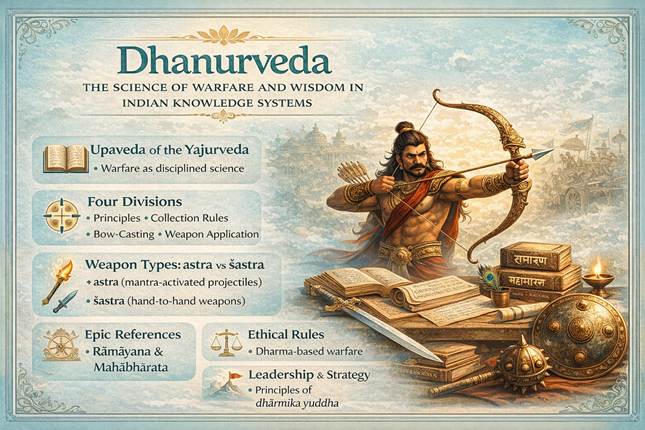
Upaveda-s are often regarded as supplementary or associated śāstra-s to the four Veda-s. The Upaveda-s present applied aspects of Vedic wisdom across various fields. Āyurveda is considered an Upaveda of the Ṛgveda. Dhanurveda is considered an Upaveda of the Yajurveda and is traditionally attributed to the sage Bhṛgu. Gāndharvaveda is associated with the Sāmaveda. Arthaśāstra is associated with the Atharvaveda by Bṛhaspati.
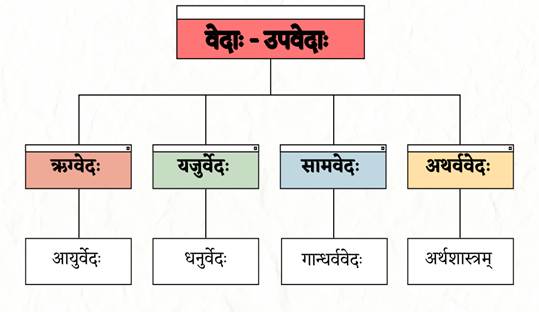
आयुर्वेदो धनुर्वेदो गान्धर्ववेदोऽर्थशास्त्रं चेति चत्वार उपवेदाः ।
āyurvedo dhanurvedo gāndharvavedo’rthaśāstraṃ ceti catvāra upavedāḥ ।
– Prasthānatrayabheda by Madhusūdanasarasvatī
The four Upaveda-s are Āyurveda (science of life), Dhanurveda (warfare), Gāndharvaveda (music and art) and Arthaśāstra (governance).
In the previous newsletters, we saw the Bhāratīya Jñāna Paramparā (IKS) framework, the details about Āyurveda (science of life) as an Upaveda. In this newsletter let us get an introduction to Dhanurveda (warfare).
The subject of Dhanurveda is recorded in several standalone books as well as in chapters of larger texts. The main ones are:
- In the Agni Purāṇa, the topic of Dhanurvidyā appears in chapters 249, 250, 251, and 252.
- In the Viṣṇudharmottara Purāṇa (Second Section, chapters 177–182) deals with the technical discipline of warfare training and the deployment of weaponry for archers, along with related matters.
- In Vasiṣṭha-Dhanurveda
- In Nītīprakāśikā
- In Śāraṅgadhara-saṁhitā
The entire Dhanurveda has been divided into four sections:
तत्र चतुष्पादात्मको धनुर्वेदः । यस्य प्रथमे पादे दीक्षाप्रकारः ।
द्वितीये सङ्ग्रहः । तृतीये सिद्धप्रयोगाः । चतुर्थे प्रयोगविधयः ॥
tatra catuṣpādātmako dhanurvedaḥ । yasya prathame pāde dīkṣāprakāraḥ । dvitīye saṇgrahaḥ । tṛtīye siddhaprayogāḥ । caturthe prayogavidhayaḥ ॥
(Vasiṣṭha’s Dhanurveda – 1.2)
Dhanurveda consists of four divisions. The first part gives instructions on the principles, the second part contains the rules for collection, the third part describes the ways of casting the bows, while the fourth part describes the application of the weapons.
Even though dhanu usually refers to a bow, it is used more broadly in texts to refer to four types of weapons based on their mode of operation.
1. Scope and Structure of Dhanurveda
This comprehensive scope of Dhanurveda is clearly expressed in the Śukranīti:
युद्धशस्त्रास्त्रकुशलो रचनाकुशलो भवेत् ।
यजुर्वेदोपवेदोऽयं धनुर्वेदस्तु येन सः ॥ ४.३.३७ ॥
yuddhaśastrāstrakuśalo racanākuśalo bhavet ।
yajurvedopavedo’yaṃ dhanurvedastu yena saḥ॥
(Śukranīti – 4.3.37)
The knowledge by which a person becomes skilled in warfare, weapons, missiles, and various battle formations is called Dhanurveda, the Upaveda of the Yajurveda.
Do you know the purpose of Dhanurveda?
Did you know that Dhanurveda classifies weapons into different types, including astra and śastra?
How are these distinctions reflected in the Rāmāyaṇa and Mahābhārata, and how are they accompanied by ethical rules of engagement and leadership principles grounded in dharma?
A detailed examination of these dimensions is available in our blog: ->->
The purpose of Dhanurveda extends beyond mere combat; it is fundamentally rooted in Dharma, the righteous protection of society and the upholding of justice. The Vasiṣṭha Dhanurveda Saṃhitā clearly articulates this moral objective:
दुष्टदस्युचोरादिभ्यः साधुसंरक्षणं धर्मतः । प्रजापालनं धनुर्वेदस्य प्रयोजनम् ।
duṣṭadasyucorādibhyaḥ sādhusaṃrakṣaṇaṃ dharmataḥ । prajāpālanaṃ dhanurvedasya prayojanam ।
(Vasiṣṭha’s Dhanurveda 1.5)
It is a sacred duty to protect the virtuous from the wicked, robbers, and thieves; the true purpose of Dhanurveda is the righteous protection of the people.
2. Classification of Weapons
Two major sources as the Dhanurveda Saṃhitā of Vasiṣṭha and the Agni Purāṇa offer distinct frameworks for classifying weapons. One is technical, the other contextual.
Although dhanuḥ primarily means “bow,” Dhanurveda expands its scope to classify weapons according to the mode of operation:
चतुर्विधमायुधम् । मुक्तममुक्तं मुक्तामुक्तं यन्त्रमुक्तञ्चेति ।
caturvidhamāyudham । muktamamuktaṃ muktāmuktaṃ yantramuktañceti ।
(Vasiṣṭha’s Dhanurveda 1.4)
Weapons are fourfold: hurled, non-hurled, both hurled and non-hurled, and mechanically discharged.
This classification reflects a sophisticated understanding of mechanics and strategy. It highlights that weaponry was seen not only as a means of offense or defense but as a śāstra, a science governed by rules, proportions, and ethical use.
Each category demanded different physical techniques and states of mind. The mukta weapons required precision and timing, amukta demanded strength and proximity, muktāmukta reflected adaptability, while yantramukta relied on calculated control and the interplay between human and mechanical energy.
In addition to these classifications, the Nītīprakāśikā attributed to Vaiśaṃpāyana introduces a distinct category termed mantramukta, referring to weapons discharged after the recitation of a mantra, such that once released, they cannot be recalled or regulated by the warrior. This description corresponds closely to the conceptual understanding of astra, i.e., weapons whose efficacy derives from spiritual invocation and ritual activation rather than solely from mechanical or muscular force.
In Amarakośa, the terms astra and śastra appear in synonymous usage, while in other textual and martial contexts they are systematically distinguished. Śastra denotes a physical weapon operated exclusively through human skill, involving strength, dexterity, and training, and functioning within the range of ordinary bodily control.
By contrast, astra designates a spiritually empowered weapon, activated and directed through mantras. Once invoked, the astra is believed to possess an autonomous potency beyond that of purely physical weapons, often appearing in epic and purāṇic literature as instruments wielded by gods, ṛṣi-warriors, or divinely instructed heroes.
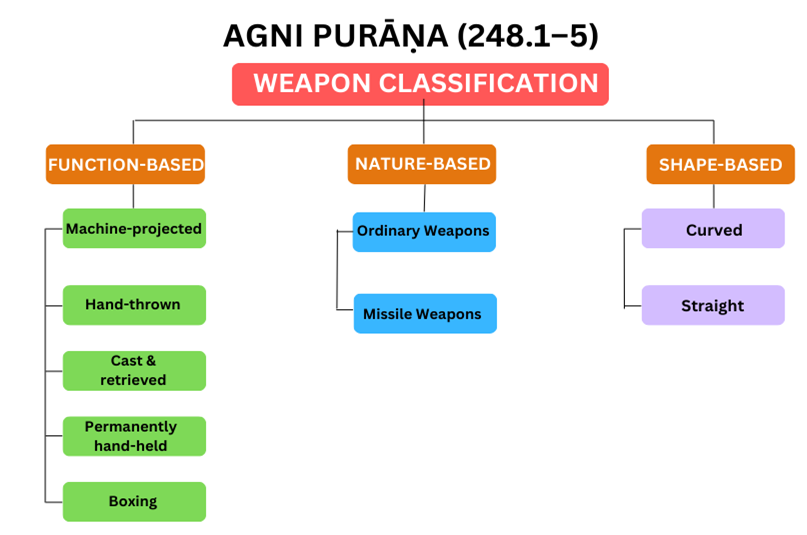
The Agni Purāṇa (248.1–3) presents Dhanurveda within a broader martial framework. It first states that Dhanurveda has four parts and is described as fivefold in application, based on the categories of warriors those fighting from chariots, elephants, cavalry, and infantry.
It then enumerates five modes of combat, rather than five kinds of weapons. Along with various modes of weapon deployment, the fifth category (bāhuyuddha) extends Dhanurveda beyond weapons to include unarmed physical combat, such as wrestling/boxing.
यन्त्रमुक्तं पाणिमुक्तं मुक्तसन्धारितं तथा । अमुक्तं बाहुयुद्धञ्च पञ्चधा तत् प्रकीर्त्तितम् ॥ २ ॥
yantramuktaṃ pāṇimuktaṃ muktasandhāritaṃ tathā । amuktaṃ bāhuyuddhañca pañcadhā tat prakīrttitam ॥
The text then further refines the classification by distinguishing combat according to weapons and missiles (śastra and astra) and according to the nature of engagement, whether direct or strategic. It is further said to be of two types, distinguished as straight and deceitful.
तत्र शस्त्रास्त्रसम्पत्त्या द्विविधं परिकीर्त्तितम् । ऋजुमायाविभेदेन भूयो द्विविधमुच्यते ॥ ३ ॥
tatra śastrāstrasampattyā dvividhaṃ parikīrttitam । ṛjumāyāvibhedena bhūyo dvividhamucyate ॥
(Agni Purāṇa 248.1–3)
(The weapons) are said to be of two kinds as ordinary weapons and missiles. They are again stated to be of two kinds by the divisions (such as) straight and curved.
Vasiṣṭha’s Dhanurveda Saṃhitā vs. Agni Purāṇa (248)
| Aspect | Vasiṣṭha’s Dhanurveda Saṃhitā | Agni Purāṇa (Chapter 248) |
| Primary Focus | Mechanics and mode of operation of weapons | Structure of Dhanurveda and battlefield application |
| Number of Categories | 4 weapon types | 5 modes of combat including unarmed such as wrestling/boxing |
| Additional Framework | Purely technical classification | Adds classification based on four types of warriors: chariot- fighters, elephant-fighters, cavalry, infantry |
3. Dhanurveda in Classical Texts
Dhanurvedic knowledge survives in a variety of textual forms, some as independent treatises and others as chapters within broader works. Classical literature mentions several Dhanurveda traditions attributed to sages such as Viśvāmitra and Bhṛgu, and Purāṇic compendia such as the Agni Purāṇa and Viṣṇudharmottara Purāṇa preserve substantial material on the subject.
In terms of extant sources, only a few texts survive that directly treat Dhanurveda. Among them, the Vasiṣṭha Dhanurveda Saṃhitā stands as the only known independent work exclusively devoted to Dhanurvidyā, presenting a systematic technical treatment. The Agni Purāṇa contains a structured Dhanurveda section that complements this technical corpus.
Additionally, the Nītīprakāśikā of Vaiśaṃpāyana, is said to have systematised this Upaveda into eight chapters. Of these, the first five chapters address the classification and definition of weapons and arms, while the remaining three chapters cover military strategy, recruitment of soldiers, appointment and remuneration of officers, and the duties of kings.
The Agni Purāṇa also preserves a substantial and structured section on Dhanurveda, offering an important complementary perspective. Other Dhanurveda texts mentioned in traditional literature, such as those attributed to Viśvāmitra, Bhṛgu of the original Upaveda tradition are no longer available.
| Text | Composer | Era | Key Areas Covered |
| Rāmāyaṇa | Vālmīki | ~500 BCE | Archery, use of divine weapons (astra-s), ethics of war, training, animal warfare |
| Mahābhārata | Vyāsa | 400 BCE–300 CE | Complete coverage: vyūha-s (battle formations), astravidyā, psychological strength, martial code, chariot warfare |
| Bhagavad Gītā (part of Mahābhārata) | Kṛṣṇa–Vyāsa | ~300 BCE | Warrior psychology, mental preparation, duty (svadharma), fearlessness |
| Arthaśāstra | Kauṭilya (Cāṇakya) | ~300 BCE | Espionage, fortifications, military economics, troop management, state defense |
| Nāṭyaśāstra | Bharata Muni | 200 BCE–200 CE | Combat gestures, war-acting techniques, symbolic martial training |
| Agnipurāṇa (Ch. 248–252) | Purāṇic compilers | ~600–900 CE | Direct summary of Dhanurveda – weapon types, stances, fourfold archery (mukta, amukta, etc.) |
| Śukranīti | Śukrācārya (traditional) | ~800–1000 CE | Kingship, war conduct, generalship, military discipline, use of spies |
Together, these texts create a continuum of martial thought from the ritualistic to the psychological, and from the ethical to the strategic.
Epic Weapon Systems: A Focus on Śastra and Astra
In order to facilitate an understanding of the Dhanurvedic weapon system, the table below enumerates selected instances of śastra and astra drawn from the Rāmāyaṇa and Mahābhārata. These epic sources attest to the sophistication of ancient Indian martial science and its well-defined technical lexicon.
List of some Astra-s mentioned in the Rāmāyaṇa and Mahābhārata
| Astra-s mentioned in Rāmāyaṇa | Reference | Astra-s in Mahābhārata | Reference |
| Indrāstra (vajraastra), Brahmāstra | 1.26.6 | Indrāstra | 8.66.48 |
| Darpaṇa-astra, Śoṣaṇa-astra, Mohana-astra | 1.26.15 | Varuṇāstra | 7.171.2 |
| Paināka-astra, Nārāyaṇa-astra | 1.26.9 | Nārāyaṇāstra | 1.2.58 |
| Mahāstra, Kalāstra | 1.55.11 | Pāśupatāstra | 3.41.13 |
| Pināka-astra, Paiśācha-astra, Krauñcha-astra | 1.55.9 | Bhārgavāstra | 8.45.34 |
| Brahmāstra, Indrāstra, Rudrāstra, Vāyavāstra, Varuṇāstra | 5.58.6 | Viśoṣaṇa-astra | 3.168.8 |
| Brahmāstra | 6.60.43 | Māyāstra | 3.230.22 |
List of some Śastra-s mentioned in the Rāmāyaṇa and Mahābhārata
| Śastra-s mentioned in Rāmāyaṇa | Reference | Śastra-s in Mahābhārata | Reference |
| Asi | 1.17.12 | asi | 5.92.22 |
| Gadā | 1.17.12 | gadā | 1.124.30 |
| khaḍga | 3.30.24 | khaḍga | 2.5.77 |
| Paraśu | 3.30.26 | paraśu | 5.34.75 |
| kuṭhāra | 3.30.31 | kuṭhāra | 5.152.7 |
| Musala | 6.74.12 | bāṇa | 3.17.12 |
| Tomara | 6.103.24 | śūla | 7.154.36 |
4. Ethical and Psychological Dimensions
Dhanurveda, like all Indian sciences, is rooted in dharma. It does not glorify violence but upholds the ideal of dhārmika yuddha, righteous warfare. The true warrior is one who protects, not one who destroys.
The texts emphasise three key ideals:
1. Śikṣā (education and discipline) – The foundation of character and mastery.
2. Nīti (policy and ethics) – Governing conduct in times of conflict.
3. Rājanīti (statecraft) – Maintaining harmony between power and morality.
Thus, Dhanurveda’s study was a complete system — blending physical skill (śārīrika śakti), mental balance (mānasika sthiratā), and ethical clarity (naitika śuddhi).
Even the act of weapon use (śastra-prayoga) was surrounded by rules: certain days were considered inauspicious for war; no battle was fought after sunset; and unarmed opponents were not to be harmed. The Mahābhārata and Śukranīti mention that deception, cruelty, or the use of forbidden weapons led to loss of merit (pātaka).
This code of conduct reveals that Indian martial culture valued restraint over aggression, seeing control of mind and senses as the highest victory.
5. Dhanurveda within Indian Knowledge Systems (IKS)
Within the IKS framework, Dhanurveda stands as a bridge between applied sciences, philosophy, and psychology. It demonstrates how knowledge systems in ancient India integrated ethics with technology and physical disciplines with metaphysical understanding.
Dhanurveda contributes to IKS in several ways:
- It preserves the roots of bhāratīya kalā – traditional Indian martial arts such as kaḷaripayaṭṭu, silambam, and gadāyuddha.
- It exemplifies the unity of śarīra, manas, and buddhi (body, mind, and intellect) as the basis of all education.
- It establishes the idea that warfare, when aligned with dharma, is a means of protection (rakṣaṇa), not domination.
- It offers a model for leadership and governance (rājadharma), which integrates valour with compassion.
6. Contemporary Relevance
In modern times, the study of Dhanurveda opens new dimensions of interdisciplinary research within IKS. Scholars and practitioners are revisiting ancient texts to rediscover the underlying principles of:
- Pāramparika yuddha-kalā – Traditional martial arts and their revival (rakṣaṇa and punarjīvana).
- Āyudhanirmiti-śilpa – The science of weapon-making and loha-śilpa (metallurgy).
- Yuddha-nīti and dharma-yuddha – The ethical code of war and governance.
- Rājadharma and Senānīti – Leadership, morale, and the psychology of command.
The ancient approach to martial education can also inform modern defense studies, sports psychology, and leadership training. The emphasis on self-mastery, discipline, and compassion resonates with today’s need for ethical military practices and stress-free decision-making.
In India’s traditional systems, strength (bala) was never separated from wisdom (buddhi). The warrior (yodha) was trained to achieve victory (jaya) not merely over enemies, but over his own inner impulses. This makes Dhanurveda profoundly relevant to contemporary dialogues on peace, ethics, and personal excellence.
Conclusion
Dhanurveda stands as a comprehensive and integrated science of warfare, uniting mechanics, ethics, psychology, and philosophy into a single knowledge system. It harmonises śastra-vidyā with śāstra-vidyā, ensuring that action is guided by dharma.
The textual evidence surveyed from the Vedas to the Epics, Purāṇa-s, and works such as the Nītīprakāśikā, demonstrates that Dhanurveda was not merely theoretical, but actively practiced, transmitted, and continuously refined within the martial traditions of ancient India. The structural distinctions between śastra and astra, and their attestation in epic narratives, reveal a lived martial culture in which technical precision and ritual discipline were all inseparably bound.
In ancient India, the battlefield was not merely a site of physical conflict but a testing ground of dharma, where moral responsibility was examined and upheld. Accordingly, the warrior was trained not only to defeat adversaries but to protect society and preserve justice.
Through its layered teachings from the physical to the metaphysical, Dhanurveda reminds us that true victory lies in self-control, and that the disciplined mind is the greatest weapon.
Research – Dr. Leena R. Doshi
Guidance – Dr. Sowmya Krishnapur, Dr. CA. Viswanathan and Dr. Venkatasubramanian P